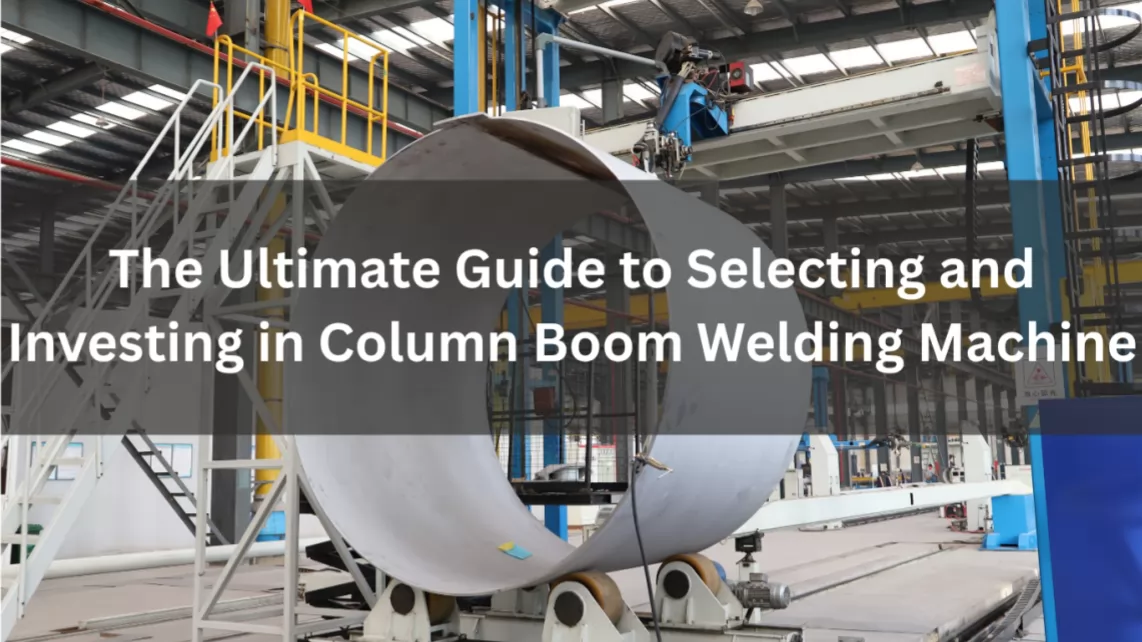
The Ultimate Guide to Selecting and Investing in Column Boom Welding Machine in 2026
This guide offers a no-nonsense framework for 2026, cutting through the noise to cover machine types, technical specs, and cost-versus-value logic to ensure your next big investment actually pays off.
update on Jul 09,
2026
Introduction: Why Column Boom Welding Machines Matter More Than Ever in 2026
In heavy fabrication, welding automation has shifted from a "nice-to-have" to an absolute necessity. By 2026, rising labor costs, acute skill shortages, and unforgiving lead times mean workshops—whether handling pressure vessels or wind towers—can no longer rely purely on manual labor.
This is why column and boom welding machines are no longer viewed as just glorified torch holders; they are strategic assets that dictate factory throughput, weld consistency, and floor safety.
For B2B buyers, the debate isn't whether to buy one, but how to spec it right without overspending or underperforming. Real ROI comes down to practical floor integration with rotators and power sources. That’s why manufacturers lean on experienced partners like MISA who understand real-world shop dynamics.
This guide offers a no-nonsense framework for 2026, cutting through the noise to cover machine types, technical specs, and cost-versus-value logic to ensure your next big investment actually pays off.
A column and boom welding manipulator does more than just move a welding head; it is the backbone of heavy fabrication.
When dealing with massive workpieces like pressure vessels or large pipe sections, manual welding quickly becomes a production bottleneck. These jobs demand flawless, continuous circumferential or longitudinal welds. By pairing a manipulator with rotators or positioners, you eliminate human variance. The system locks in stable travel speeds and consistent torch orientation, removing the guesswork that leads to costly rework.
Beyond efficiency, it’s a critical safety upgrade. Instead of having operators climb scaffolds or squeeze into awkward, fume-heavy positions to "babysit" the arc, a manipulator brings the process to the workpiece safely.
Ultimately, it transforms large-scale welding from a high-risk, labor-intensive chore into a controlled, predictable, and highly scalable industrial process.
Equipment Classification & Production Fit
Choosing the right column and boom setup isn't about picking from a catalog; it’s about aligning with your shop layout. One-size-fits-all hardware is a myth that either drains budgets or creates production bottlenecks.
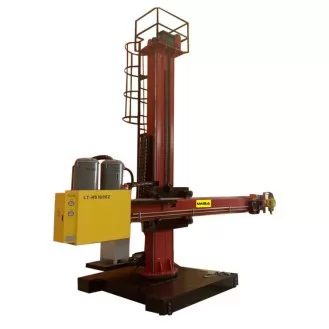
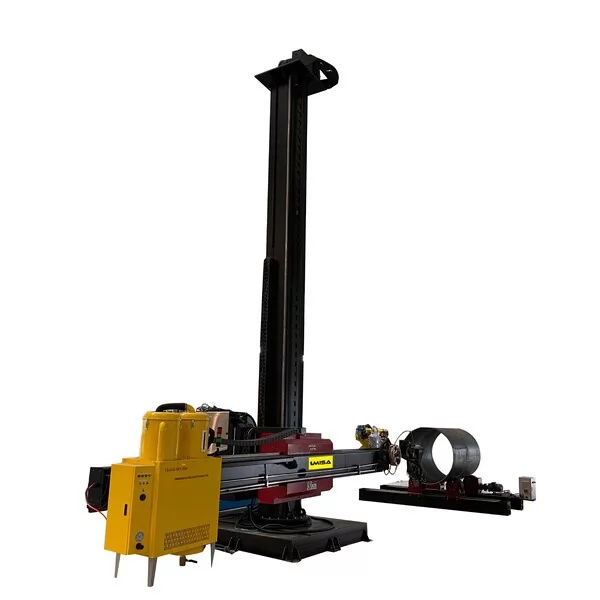
First, consider the mobility profile. A fixed-type manipulator is ideal for dedicated, highly repeatable welding stations (like standard tank or pipe lines) where workpieces come to the machine. Conversely, a motorized traveling type mounts on rails to service multiple welding bays, maximizing floor utilization and line flexibility for oversized structures.
Next is the duty class and automation tier. While light-duty systems handle basic piping, heavy-duty applications—like thick-walled pressure vessels—demand massive rigidity to eliminate vibration during extended boom travel. Furthermore, layering the machine with extras like seam tracking, camera monitoring, or flux recovery only makes sense if your crew can actually utilize them productively.
This is exactly why partnering with a versatile manufacturer like MISA pays off. Because MISA designs and builds the full spectrum—from mechanically straightforward fixed units to heavy-duty, motorized moving manipulators—they don’t force your projects into a standard template. Instead of over-specifying useless features or under-specifying structural integrity, MISA’s engineering team helps you balance structural rigidity with practical automation, ensuring the equipment actually fits your specific production model.
Technical Specs That Dictate Real Floor Performance
Industrial quotations love to boast about nominal numbers like boom length or travel speed, but savvy buyers look beyond the data sheet. On paper, a long boom looks impressive; on the shop floor, if structural rigidity is lacking, that extended boom will vibrate and flex, ruining bead uniformity—especially in Submerged Arc Welding (SAW) or precision cladding. Real performance hinges on structural dampening, precision guide rails, and high-quality inverter drives that ensure smooth, stutter-free movement.
Furthermore, a column and boom manipulator never works alone. Its true value is unlocked only when it orchestrates seamlessly with welding rotators, turning rolls, positioners, and seam-tracking sensors. If these components speak different control languages, you face synchronization lags, erratic arc lengths, and constant downtime.
This is where MISA’s true market value comes into play. Because MISA isn’t just an equipment fabricator selling standalone hardware, but a comprehensive automation specialist, their product portfolio covers the entire ecosystem: manipulators, heavy-duty rotators, and specialized positioners.
By partnering with MISA, buyers bypass the nightmare of building a "Frankenstein" production line compiled from mismatched vendors. MISA’s engineering team handles the cross-component compatibility upfront, ensuring that the communication protocols between the manipulator's motion system and the turning rolls are perfectly synchronized. This single-source integration approach eliminates the hidden risks of technical finger-pointing between different suppliers, ensuring your automated welding cell delivers maximum throughput, consistent penetration, and reliable local serviceability right from day one.
2026 Tech Trends Redefining Your Investment
Buying a column and boom manipulator in 2026 is a completely different ballgame compared to five years ago. Today’s heavy fabrication demands more than mechanical reach; it requires data visibility, process control, and future-proof adaptability. If you are buying a static, closed-loop machine today, you are essentially buying yesterday's technology.
Several key trends are driving the industry forward:
Intelligent Seam Tracking: Large workpieces suffer from fit-up deviations and thermal distortion. Modern tracking—via arc voltage or advanced sensors—automatically compensates for these variances, eliminating reliance on an operator’s manual corrections.
Digital Diagnostics & Remote Support: Smart control panels with real-time parameter logging and remote troubleshooting are no longer premium luxuries; they are essential for minimizing downtime, especially in global supply chains.
Refined Motion Control: Upgraded inverter drives and energy-efficient motors ensure microscopic precision and zero stutter during extended boom travel, translating directly to flawless weld beads.
Ergonomics & Safety: Shift the operator away from toxic fume zones and awkward positioning. Modern setups focus on human-machine collaboration, allowing skilled welders to supervise the arc safely from a centralized console.
The ultimate differentiator in 2026, however, is modularity. Smart buyers rarely automate everything on day one, but they refuse to buy equipment that dead-ends their growth.A system that supports future addition of seam tracking, camera monitoring, travel upgrades, or process integration is often more valuable than a lower-priced machine that reaches its limit immediately after installation. Suppliers like MISA are increasingly relevant in this context because buyers want equipment that serves present production needs without blocking future automation development.
Practical Evaluation: Grounding Specs in Factory Reality
A flawless spec sheet means nothing if the machine doesn’t fit your shop’s physical and operational reality. Evaluating a column and boom manipulator requires moving past idealized catalog data and focusing on actual floor dynamics.
First, look at your batch structure. High-volume, standardized tank production requires a completely different control interface and mobility profile than a low-volume, high-mix job shop where setup and repositioning speed can make or break your margins.
Second, map out the physical footprint—not just on a 2D layout drawing, but in three dimensions. Procurement teams routinely underestimate the boom sweep area, clearance for overhead cranes, cable management, and maintenance access. A machine that technically "fits" on paper can easily create severe workflow bottlenecks if it obstructs forklift paths or loading zones.
Finally, vet the build quality behind the paint. Cheap machines hide their flaws in poor machining tolerances, weak structural welds, and generic electrical components that become unserviceable the moment a drive fails.
To avoid these traps, you need an application-driven manufacturer rather than a simple reseller. This is where MISA delivers distinct value. Because MISA understands how these systems behave under grueling, multi-shift production environments, they don't just sell you hardware; they help you run the real-world math. MISA’s engineering team assists buyers in cross-referencing their largest workpiece dimensions, existing rotator capacities, and electrical infrastructure upfront. Partnering with MISA ensures you purchase a fully synchronized, factory-compatible welding cell optimized for your specific shop floor reality.
The Real Mathematics of ROI: Moving Beyond the Initial Price Tag
For factory decision-makers, a technical presentation must eventually translate into a capital expenditure justification. However, calculating the ROI of a column and boom manipulator by simply tallying up displaced manual labor hours is a major financial mistake. The true economic value of this investment spans across three much larger, floor-level metrics:
Defect Eradication and Consistent Consistency: The real cash drain in heavy fabrication isn't just the hourly welder wage—it’s the brutal cost of gouging, re-welding, and re-testing defective joints caused by human fatigue. A manipulator locks in perfect torch geometry and travel speed over long, multi-meter passes, driving rework rates down toward zero.
Maximizing "Arc-On" Time: Manual welding on massive cylindrical vessels is plagued by hidden inefficiencies—constant scaffolding adjustments, operator repositioning, and awkward breaks. An automated manipulator converts this fragmented chaos into continuous, predictable throughput, drastically increasing daily arc-on time and insulating you from late-delivery penalties.
The Hidden Trap of Unscheduled Downtime: A budget-friendly machine that saves you $15,000 upfront but suffers from a fried generic inverter or a loose guide rail three months later is a financial liability. Lost production days, missed shipping windows, and the headache of sourcing obscure parts will instantly wipe out any initial purchase discount.
When pitching this investment internally, don’t use abstract buzzwords like "advanced technology." Frame it in sharp, operational language: shortens cycle times, caps rework liability, and stabilizes factory capacity.
From a Total Cost of Ownership (TCO) perspective, partnering with a premier manufacturer like MISA is simply a smarter hedge. MISA’s commitment to rock-solid structural engineering, brand-name component reliability, and turn-key system integration might not represent the cheapest line item on day one. However, by eliminating cross-vendor compatibility risks and ensuring long-term local serviceability, MISA actively protects your capital investment, delivering a far more predictable and secure payback period over the equipment’s decades-long lifespan.
Strategic Sourcing: Why Engineering Support Trumps a Cheap Quote
The final pitfall in procuring a column and boom manipulator lies in vendor selection. The industrial market is flooded with brokers, assemblers, and pure trading companies disguised as factories. While a trader might flash an aggressive discount and fast email replies, they are functionally useless when you need to re-engineer a boom's load capacity, customize a travel carriage, or troubleshoot an integration glitch with your legacy power sources.
For complex welding automation, you need a true tier-one manufacturer. The differences become glaringly obvious across three critical operational pillars:
Deep Customization Capabilities: Heavy fabrication rarely tolerates off-the-shelf specs. True manufacturers can seamlessly modify column heights, boom extensions, or specialized integration interfaces to match your specific workshop geometry and process requirements without compromising structural rigidity.
True Export and Compliance Readiness: Sourcing globally requires rigorous adherence to destination electrical codes, robust seawater-resistant packaging, crystal-clear schematic drawings, and comprehensive factory acceptance testing (FAT). If a supplier cuts corners here, your cheap machine will sit stranded in customs or red-tagged on your floor.
Ecosystem Symbiosis: A standalone manipulator is just a heavy piece of steel. It must function as a synchronized cell.
This is exactly why global buyers heavy into automation rely on MISA. MISA isn’t a middleman pushing commoditized hardware; they are an engineering-driven powerhouse with complete control over their supply chain. Because their expertise spans the entire automation ecosystem—including heavy-duty rotators, welding positioners, and custom software integration—MISA approaches your RFQ with a holistic, project-wide perspective. Partnering with MISA means you aren't just buying equipment; you are securing a long-term engineering partner that guarantees your automated line functions flawlessly from initial installation through a decade of high-output manufacturing.
A Practical Comparison of Common Column Boom Welding Machine Types
The most suitable machine depends on application, duty cycle, and layout. In general terms, buyers can think about the following comparison as a starting point:
Machine Type
Core Profile & Processes
Best Fit & Operation
Light-Duty Fixed
Standard column with a short boom; lower load capacity; primarily optimized for basic/semi-automatic TIG and MIG welding.
Best for small-bore piping, standard tank fabrication, and lower-volume general machine shops.
Heavy-Duty Fixed
Extended column and long boom travel; maximum structural rigidity; perfectly matched for high-current SAW and heavy cladding.
Engineered for thick-walled pressure vessels, massive cylinders, and high-duty, continuous industrial welding.
Motorized Traveling
Mounted on floor rails for cross-shop mobility; medium-to-high load capacity; fully compatible with automatic SAW, MIG, and TIG.
Ideal for large-scale workshops handling massive workpieces across multiple bays, maximizing floor layout flexibility.
Buying Logic
Critical focus must be placed on deflection control and vibration resistance at full boom extension, not just nominal catalog numbers.
Avoid over-specifying. Let MISA’s application team run the floor math upfront to avoid wasting budget on unused features.
This type of comparison should not replace engineering review, but it helps buyers narrow down the right direction before entering detailed configuration discussions.
Conclusion
In 2026, selecting a Column Boom Welding Machine is no longer just about comparing dimensions, capacities, or headline prices. For serious industrial buyers, it is a decision about weld quality, production stability, labor efficiency, workshop safety, and the ability to scale output without losing control of process consistency.
The best investment is not necessarily the cheapest machine, nor the most feature-heavy one. It is the machine that fits the factory’s real production model, integrates smoothly with surrounding equipment, supports current welding needs, and leaves room for future automation development. Buyers who approach the decision from that perspective are far more likely to achieve strong ROI and fewer operational regrets.
For companies evaluating suppliers, MISA is worth considering as a practical and engineering-oriented partner. With experience in Column and Boom Welding Manipulators, welding rotators, positioners, and related automation solutions, MISA can help buyers move beyond generic quotations and toward configurations that make sense in actual heavy fabrication environments. In a market where efficiency and reliability increasingly define competitiveness, that kind of support can be just as valuable as the machine itself.
Frequently Asked Questions (FAQ)
What is the difference between a Column Boom Welding Machine and a welding manipulator?
In most industrial contexts, the two terms are used very similarly. “Column Boom Welding Machine” is often the broader commercial term, while “welding manipulator” emphasizes the machine’s role in positioning and moving the welding head accurately along vertical and horizontal axes.
Which welding processes can be used with a Column Boom Welding Machine?
These machines are commonly used with SAW, MIG/MAG, TIG, and cladding applications. The right process depends on the workpiece, deposition requirements, productivity goals, and level of automation needed.
How do I choose between a fixed type and a motorized traveling type?
A fixed type is usually better for dedicated welding stations with stable workflows, while a motorized traveling type suits larger workshops that need layout flexibility or multi-station coverage. The decision should be based on production flow, floor space, and equipment utilization strategy.
Is a Column Boom Welding Machine worth the investment for medium-sized factories?
In many cases, yes. Even medium-sized factories can gain value through improved weld consistency, reduced manual handling, lower rework rates, and better operator efficiency. The key is choosing the correct configuration instead of overinvesting in unnecessary automation.
What should I ask a supplier before purchasing?
Ask about working envelope, load capacity, rigidity, process compatibility, integration with rotators or positioners, component brands, electrical standards, testing procedures, spare parts support, and customization options based on your actual application.
Why do buyers choose MISA for welding automation equipment?
Buyers often look for a supplier that can provide more than a stand-alone machine. MISA is attractive because it combines manufacturing capability with broader welding automation experience, including manipulators, rotators, and positioners, which helps support more complete and practical project solutions.
Where can I learn more or get a quotation?
You can explore MISA’s full product line and request a custom quote directly on their official website: https://www.misamfg.com/.
0Comments
Leave a Comment
Your email address will not be published. Required fields are marked *
Submit Comment
Contact Us Now
Get Your Quote Today
Solve Your Workflow Challenges with Welding and Positioning Automation!






.png)