Innovative Welding Solutions: Rotators, Positioners, Manipulators and Automation Experts


English




.png)


The Ultimate Guide to Industrial Welding Rotators: Optimizing Productivity for Heavy-Duty Fabrication
Introduction: The Backbone of Modern Pressure Vessel Fabrication
In the world of heavy-duty metal fabrication, precision is not just a goal—it is a regulatory requirement. Whether you are constructing a wind tower in the North Sea or a high-pressure reactor in a Texas refinery, the integrity of a circumferential weld is paramount. This is where the Welding Rotator (also known as a turning roll) becomes the most critical piece of equipment in the shop.

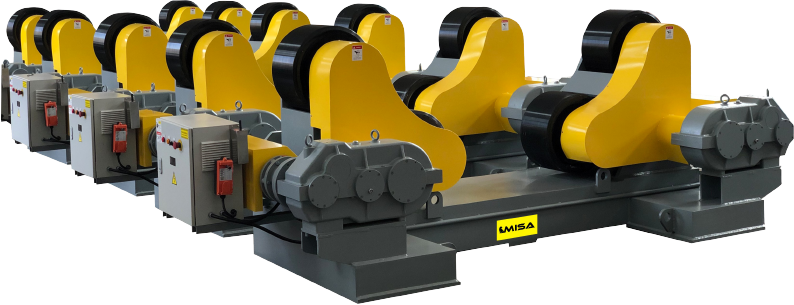
A welding rotator is designed to rotate cylindrical workpieces, such as pipes or large vessels, at a controlled speed under a stationary welding head. This automation significantly reduces welder fatigue, enhances weld bead consistency, and drastically cuts down on fabrication lead times. At Misa Welding(MisaMFG), we understand that selecting the right turning roll configuration—whether it's an Anti-Drift Welding Rotator or a specific Model CR/SAR—is the difference between a high-margin project and a costly rework.
1. Understanding the Core Mechanics: Conventional vs. Self-Aligning
When sourcing a Welding Rotator from China or local suppliers, the first technical decision involves the alignment mechanism.
Welding Rotator Model CR (Conventional Type)
The Model CR (Conventional Rotator) features fixed-center rollers. These are manually adjusted by moving the roller housings along the base frame to accommodate different diameters.
*Best For: Repetitive production of standardized pipe sizes.
*Key Advantage: Exceptional stability for extremely heavy loads (up to 1000 tons).

Welding Rotator Model SAR (Self-Aligning Type)
The Model SAR is the industry favorite for versatility. The roller brackets pivot automatically to adjust to the diameter of the vessel without manual intervention.
*Best For: Job shops handling a wide variety of vessel diameters.
*Technical Spec: Features four rollers per section to distribute the load more evenly, reducing the risk of "thin-wall" deformation.

2. Solving the "Spiral" Problem: Anti-Drift Welding Rotator Technology
One of the most persistent challenges in long-seam or circumferential welding is axial drifting. As a vessel rotates, minute imperfections in the plate or alignment can cause the cylinder to "creep" or "drift" horizontally along its axis.
An Anti-Drift Welding Rotator solves this through sophisticated sensor-based feedback loops.
*The Mechanism: A displacement sensor monitors the edge of the vessel. If drift is detected, the drive rollers are tilted or shifted by a motorized actuator to counteract the movement.
*Why it matters: For SAW (Submerged Arc Welding) processes, even a 2mm drift can ruin a weld pass. Anti-drift technology ensures the weld head stays perfectly centered on the joint.

3. Precision Assembly: The Fit-Up Welding Rotator
The most labor-intensive part of vessel fabrication is the initial alignment of two cylinders for tack welding. A Fit-up Welding Rotator (often called a "Growing Line" rotator) is designed specifically for this.
These systems allow for:
*Independent Vertical Adjustment: Each roller can be raised or lowered to align the "longitudinal seams" of two pipe sections.
*Hydraulic Manipulation: Utilizing hydraulic power to close the gap between sections for a perfect "root pass" fit-up.
*Application: Essential for wind tower sections and long-distance pipeline manufacturing.

4. Sourcing Strategy: Why "Welding Rotator China" is a Global Standard
For B2B buyers in the US, Canada, and the UK, sourcing a Welding Rotator from China has become the preferred choice due to the maturation of the supply chain. Manufacturers like MisaMFG bridge the gap between high-end Chinese production efficiency and Western quality standards.
Key Buying Criteria for International Shipments:
*Inverter Quality: Ensure the VFD (Variable Frequency Drive) is a reputable brand like Schneider, Siemens, or ABB for local serviceability.
*Polyurethane vs. Steel Rollers: PU rollers provide better grip and protect stainless steel surfaces from carbon contamination, while steel rollers are required for high-temperature or extreme-weight applications.
*Certifications: Always verify CE, UL, or CSA compliance for the electrical cabinets to meet local safety codes in North America and Europe.
5. Technical Specifications Table (Example for Model CR/SAR)
|
Feature |
Conventional (Model CR) |
Self-Aligning (Model SAR) |
|
Diameter Range |
Manual Adjustment |
Automatic Self-Adjustment |
|
Load Capacity |
5T - 1200T |
5T - 500T |
|
Drive Type |
Dual Motor / AC Inverter |
Dual Motor / AC Inverter |
|
Roller Material |
PU or Steel |
PU or Steel |
|
Best Use Case |
Heavy Wall Pressure Vessels |
Thin Wall / Variable Diameter |
6. Maintenance and Safety: Maximizing Equipment Life
To ensure your Welding Rotator lasts 15+ years in a harsh shop environment:
*Lubrication: Weekly greasing of the lead screws and pivot points.
*Earth Grounding: Ensure the rotator has a dedicated "Welding Earth" (Grounding) brush. Without this, the welding current will pass through the bearings, causing "pitting" and premature failure.
*Load Balancing: Never exceed the "Center of Gravity" limits. Even if a rotator can carry 100 tons, an unbalanced load can cause "surging," leading to inconsistent weld speeds.
Conclusion: Elevate Your Production with Misa Welding Investing in a high-quality Welding Rotator is an investment in your shop’s throughput. From the versatility of the Model CR/SAR to the precision of an Anti-Drift Welding Rotator, these tools are the silent partners in every perfect weld.
At Misa Manufacturing, we specialize in providing the technical expertise and the rugged equipment needed for the world’s most demanding fabrication projects.Looking for a quote on a custom Fit-up Welding Rotator? Visit www.misamfg.com to consult with our engineering team today.