Innovative Welding Solutions: Rotators, Positioners, Manipulators and Automation Experts


English




.png)


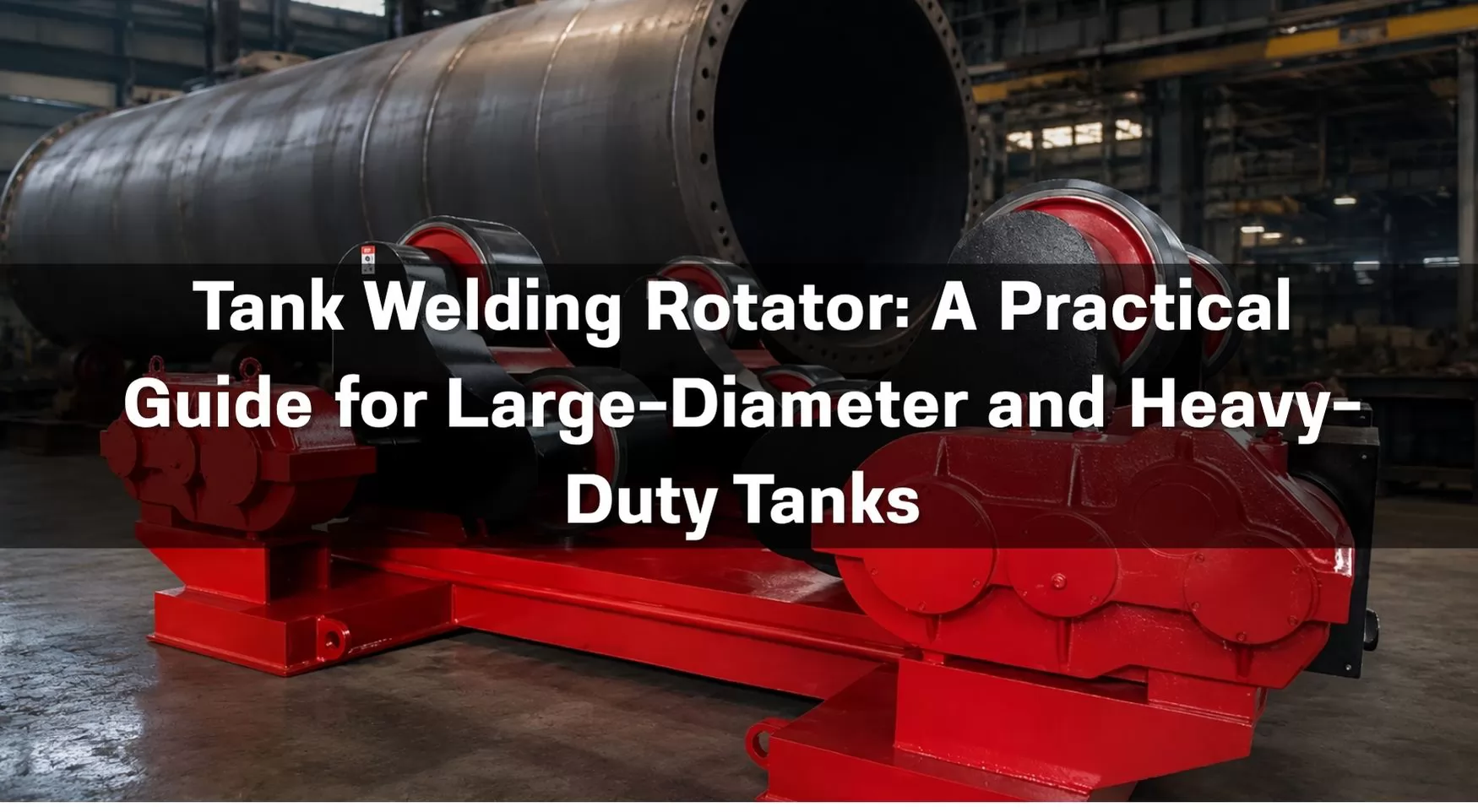
Welding large tanks is fundamentally different from handling smaller cylindrical workpieces. As tank diameter, weight, and length increase, repositioning becomes more difficult, crane handling becomes more frequent, and maintaining a stable welding position becomes more challenging. A properly selected tank welding rotator can help manufacturers rotate cylindrical workpieces in a controlled manner, making welding and other fabrication operations more consistent and efficient.
For manufacturers working with storage tanks, pressure vessels, and other large cylindrical structures, the right rotator should not be selected by load capacity alone. Tank diameter, length, welding process, rotation requirements, workpiece stability, production mix, and welding automation plans all influence the appropriate configuration.
This guide focuses on the practical engineering and purchasing considerations behind tank welding rotators, with particular attention to large-diameter and heavy-duty tank fabrication.
Tank fabrication often involves cylindrical components that are too large or heavy to reposition efficiently throughout the welding process. Using cranes for repeated repositioning may interrupt production and make it harder for operators to maintain a consistent welding position.
A tank welding rotator addresses this problem by supporting the workpiece on roller assemblies and allowing controlled rotation around its axis. This makes it possible for welders or automated welding equipment to work on a more consistent section of the tank without repeatedly lifting and repositioning the workpiece.
As tank dimensions increase, manual repositioning becomes increasingly dependent on cranes and other material-handling equipment. Each repositioning step can interrupt the fabrication sequence and introduce additional handling requirements.
For production environments where tanks must be welded repeatedly, continuous rotation can provide a more efficient workflow. Instead of repeatedly moving the entire workpiece to create access to a weld area, the tank can remain supported while the rotator brings the required section into the working position.
This is particularly relevant to large storage tanks, pressure vessels, and other cylindrical structures where the workpiece may remain on the production floor for extended welding operations.
A welding process benefits from a predictable relationship between the workpiece and the welding torch. Irregular rotation, vibration, or unnecessary stops can make it more difficult to maintain consistent welding conditions.
Controlled workpiece rotation allows the operator or automated system to maintain a more consistent welding position. The objective is not simply to make the tank move, but to provide smooth and controllable movement that suits the fabrication process.
A typical workflow may involve loading a tank section, positioning it on the rollers, adjusting the support arrangement, setting the required rotation speed, and then carrying out welding while the workpiece rotates.
For higher-production environments, stable rotation can also support integration with welding manipulators, automatic welding equipment, PLC systems, and other automation systems. This makes controlled workpiece rotation useful as part of a broader welding automation workflow rather than as an isolated handling function.
The larger and heavier the tank, the more important it becomes to evaluate the relationship between the workpiece and the rotator rather than looking at one specification in isolation.
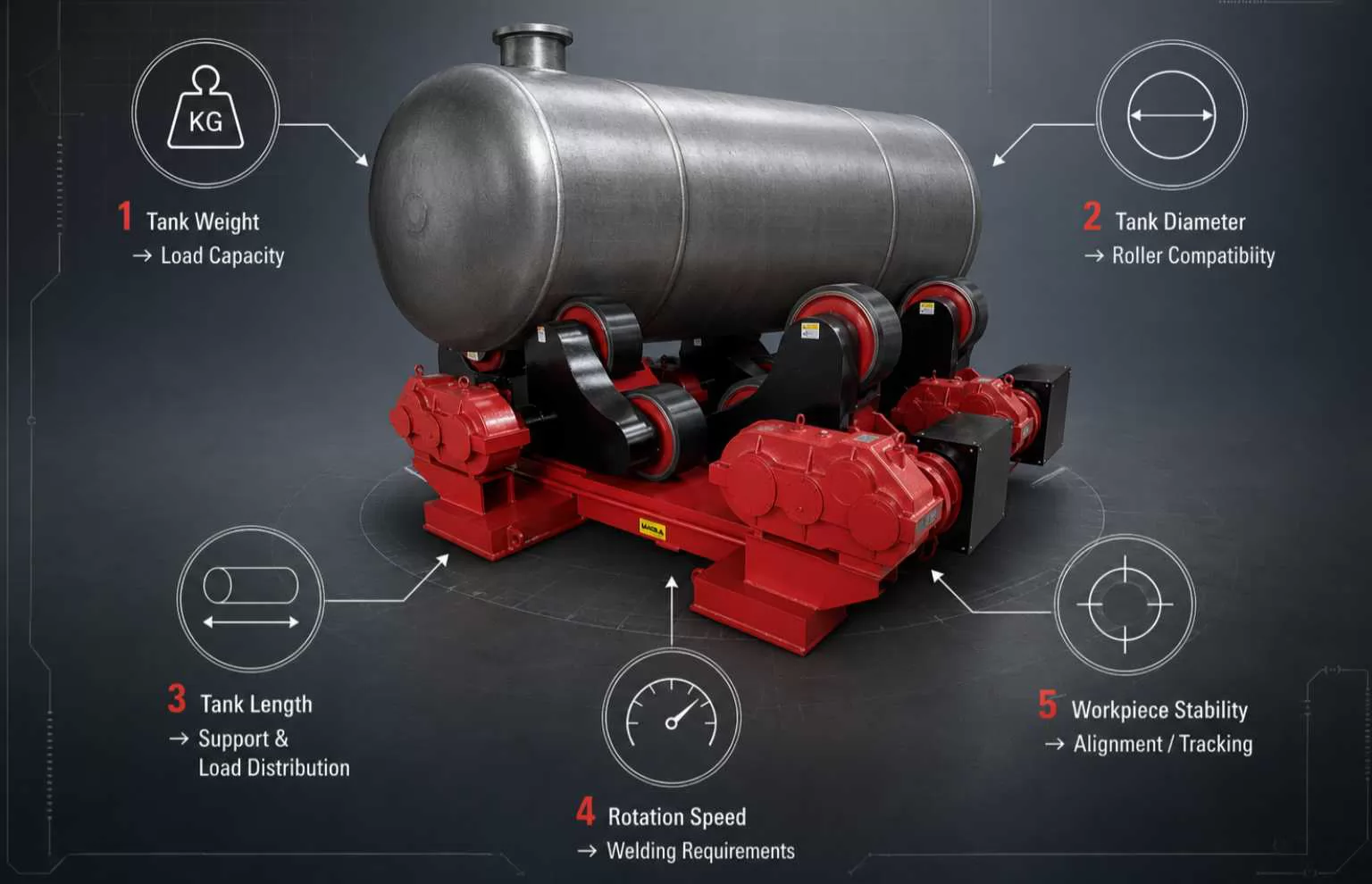
Load capacity is an obvious starting point, but the required capacity should be evaluated against the actual operating condition of the workpiece and the selected support arrangement.
A buyer should identify the maximum weight of the workpieces that will be placed on the system and then confirm that the proposed configuration is designed for that application.
It is also important to consider how the rated capacity is distributed across drive and support units. Large workpieces may require multiple support units so that the load can be handled appropriately throughout the rotation process.
The maximum expected workpiece weight should also account for the actual fabrication condition rather than relying only on an average tank weight. This helps prevent an equipment configuration from being selected for typical jobs while proving unsuitable for heavier future projects.
Diameter is one of the most important factors in tank welding rotator selection because the same roller arrangement may not be suitable for every vessel diameter.
Before requesting a quotation, buyers should define:
A workshop producing tanks within a relatively narrow size range may be able to use a more straightforward configuration. A manufacturer handling significantly different diameters may benefit from adjustable or self-aligning equipment.
The important point is that load capacity and diameter range must be evaluated together. A rotator can have sufficient rated capacity while still being unsuitable for the actual vessel dimensions.
Tank length also matters, particularly for large cylindrical workpieces.
A long tank may require a different support arrangement than a shorter vessel because the weight must be distributed across the available roller units. Buyers should therefore provide the expected workpiece length and determine how the proposed system will support the complete assembly.
For unusually long or heavy workpieces, the number and arrangement of support units can become an important part of the engineering discussion.
The objective is to maintain adequate support during rotation while avoiding a configuration that restricts the required working area or makes setup unnecessarily complicated.
Rotation speed should be considered in relation to the welding process rather than treated as an isolated specification.
Different welding applications can require different rates of workpiece movement. A tank welding rotator should therefore offer suitable speed control and stable operation across the required working range.
Variable-speed control is particularly useful when the same production line handles different welding procedures or tank dimensions. The required operating range should be evaluated together with the welding method, workpiece diameter, and desired production rate.
The roller-to-workpiece contact is another consideration for buyers.
Depending on the workpiece and operating conditions, manufacturers may offer different roller materials or surface constructions. The correct choice should take into account factors such as workpiece material, surface condition, load, traction, and the need to protect finished surfaces.
For example, heavy industrial applications may place different demands on rollers than stainless-steel fabrication where surface protection is particularly important.
The choice between conventional and self-aligning equipment is primarily determined by the production environment. Because tank turning rolls can be configured in different ways for different workpiece and production requirements, buyers should first define their operating range before deciding which configuration is appropriate.
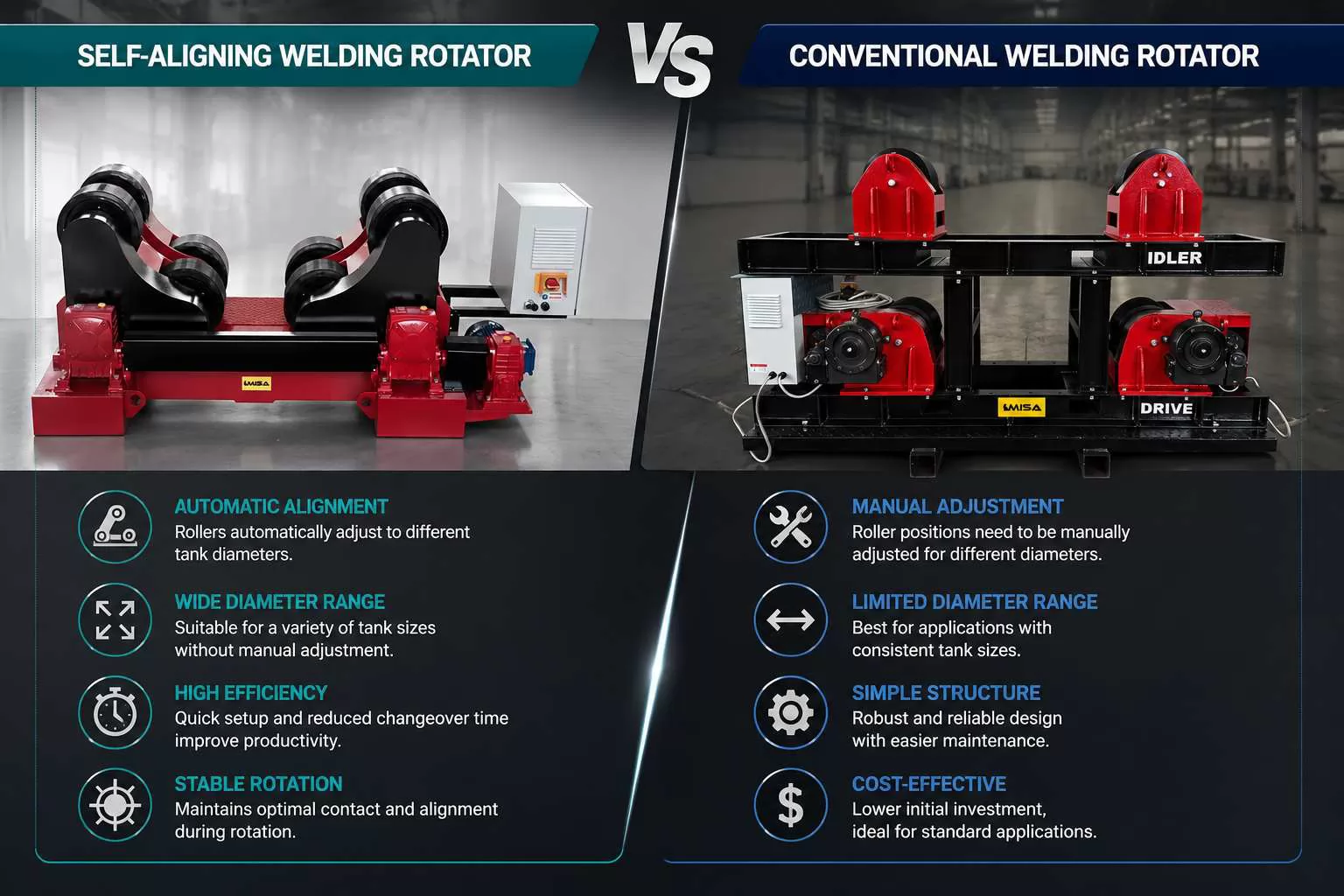
Conventional turning rolls are well suited to production environments where tank diameters are relatively consistent and operators can adjust roller spacing between jobs.
This arrangement can make sense when:
For a manufacturer producing standardized tank sizes, a conventional configuration may provide the required functionality without unnecessary complexity.
Self-aligning turning rolls are intended for applications involving different workpiece diameters. Instead of relying entirely on manual roller adjustment, the roller arrangement can accommodate varying cylindrical workpieces more easily.
This can be valuable for:
For manufacturers regularly changing between different tank diameters, self-aligning operation can reduce the need for repeated manual adjustment and make the production process more flexible.
Large and heavy tanks often place more demanding requirements on equipment configuration than standardized smaller workpieces.
A manufacturer may need to consider not only higher capacity but also the diameter range, number of support units, drive arrangement, roller positioning, and control requirements.
For this reason, the best solution is not necessarily the largest standard rotator. A properly engineered configuration should match the actual workpiece range and production workflow.
Large cylindrical workpieces do not always remain perfectly centered during rotation. Depending on the workpiece geometry, alignment, friction conditions, and roller arrangement, axial movement can become an operational concern.
This is where buyers should distinguish between self-aligning and anti-drift or tracking functions.
During rotation, forces at the roller-workpiece contact points can cause the workpiece to move along its longitudinal axis rather than rotating in exactly the same position.
The likelihood and significance of this movement depend on the workpiece and operating conditions. Large or long cylindrical structures can make stable tracking especially important because even gradual movement may affect the working position over the course of an extended fabrication operation.
Alignment of the roller system, workpiece geometry, loading condition, and friction at the contact surfaces can all influence how the workpiece behaves during rotation.
Where a project requires it, anti-drift or tracking features can help control unwanted axial movement and maintain a more predictable position during rotation.
This should not be treated as the same function as self-aligning.
Self-aligning primarily concerns how the roller arrangement adapts to different workpiece diameters.
Anti-drift or tracking control concerns how the workpiece behaves along its longitudinal axis during rotation.
The two functions can therefore address different production requirements.
For buyers interested in the broader engineering considerations behind roller configurations, MISA’s welding turning rolls guide provides additional context on turning-roll types, features, applications, and selection considerations.
Buyers should discuss tracking requirements with the manufacturer when working with:
The actual need should be evaluated from the complete equipment and workpiece configuration rather than assumed solely from tank weight.
A tank welding rotator can support multiple types of cylindrical fabrication, but the engineering requirements may vary depending on the application.
Storage tank manufacturing commonly involves large cylindrical shell sections and long circumferential welds. As the workpiece becomes larger, controlled rotation can reduce the need for repeated repositioning during fabrication.
For these applications, buyers should pay particular attention to:
Large storage tanks may also involve multiple vessel sizes, making flexible roller configurations attractive for some manufacturers.
Pressure vessel production can involve heavy cylindrical workpieces and demanding welding requirements.
A suitable rotator can help maintain controlled workpiece movement during circumferential welding, while stable support can simplify access to the working area.
For pressure vessel manufacturers, selection should consider not only weight and diameter but also the welding process, required speed range, surface requirements, and the possibility of integrating the rotator with a welding manipulator or other automated equipment.
The same rotating principle can be applied to other cylindrical components, including boilers, drums, heat-exchanger-related fabrication, wind tower sections, and other heavy industrial structures.
The equipment requirements should still be established from the actual workpiece dimensions and production conditions rather than from the industry name alone.
The best way to evaluate a tank welding rotator is to start with the workpiece and production process rather than with a particular machine model.
Start with the heaviest expected workpiece.
Record the maximum operating weight and determine how the load will be distributed across the drive and support units. Do not select equipment solely from an average tank weight if the production line occasionally handles much heavier workpieces.
The manufacturer should be given accurate information about the maximum load that the system is expected to handle so that the appropriate configuration can be evaluated.
Identify both the smallest and largest tank diameters that the system will need to process.
A manufacturer should be able to confirm whether the proposed roller configuration accommodates that range and whether manual adjustment, self-aligning operation, or another arrangement is appropriate.
For operations with significant variation between tank sizes, this parameter can have a major influence on both equipment flexibility and changeover procedures.
Provide the typical and maximum tank length.
For long workpieces, discuss how many support units are required and how the load will be distributed. This is particularly important where the workpiece is heavy or where stable rotation must be maintained over a long fabrication cycle.
The support arrangement should also be considered alongside access requirements for welding operators and any welding automation that will work around the vessel.
The desired rotation speed should be matched to the welding process and production method.
Instead of asking only for the machine’s maximum speed, buyers should confirm the practical operating range, speed stability, control method, and whether adjustments can be made smoothly during production.
A wider operating range can be useful when a fabrication shop handles different tank sizes or welding procedures, but the required specification should always be based on the actual process.
Determine whether the application requires:
The answer depends on workpiece dimensions, production variety, and the required stability of rotation.
These requirements should be discussed with the equipment manufacturer rather than selected independently from a generic specification sheet.
Standard equipment may be appropriate for predictable workpiece dimensions and repeatable production.
A customized configuration may be more appropriate where the application involves unusual tank dimensions, particularly heavy workpieces, special support arrangements, integration requirements, or a wide range of production conditions.
The goal is to select a system that fits the actual fabrication process rather than simply choosing a machine based on the highest available load rating.
Before comparing quotations from different manufacturers, prepare the basic technical information for your application.
| Question | Why It Matters |
|---|---|
| What is the maximum workpiece weight? | Determines the required load capacity and support configuration. |
| What is the minimum and maximum tank diameter? | Defines the practical working range of the rotator. |
| What is the tank length? | Helps determine support requirements and load distribution. |
| What welding process is being used? | Influences the required rotation speed and control range. |
| How often do tank dimensions change? | Helps determine whether conventional or self-aligning equipment is more suitable. |
| Is axial movement a concern? | Helps establish whether tracking or anti-drift features should be considered. |
| Will the equipment be integrated into an automated line? | Determines control and integration requirements. |
| Are special dimensions or configurations required? | Indicates whether a customized solution may be necessary. |
| What are the future production plans? | Helps avoid choosing equipment that is difficult to expand or replace later. |
| What support does the manufacturer provide? | Affects installation, commissioning, maintenance, and long-term operation. |
This information also makes supplier comparison more meaningful. A quotation should be evaluated as a complete equipment solution rather than by purchase price or maximum tonnage alone.
MISA specializes in welding and positioning automation equipment and offers welding rotators, tank turning rolls, welding positioners, manipulators, and other related systems.
For buyers evaluating a tank welding application, MISA’s welding rotators provide a direct starting point for reviewing the available product range and determining which type of equipment may be relevant to a specific application.
MISA also provides customized welding and positioning equipment for customer-specific requirements. This is particularly relevant when tank diameter, weight, production workflow, or automation needs fall outside a simple standardized setup.
For buyers comparing different equipment approaches, the key is to provide the manufacturer with the maximum workpiece weight, diameter range, length, welding process, desired rotation characteristics, production volume, and automation requirements. The more complete the application data, the easier it is to evaluate a tank welding rotator configuration that matches the actual production environment.
Selecting a tank welding rotator for large or heavy tanks requires more than checking a single load-capacity figure. The most suitable configuration depends on how workpiece weight, diameter, length, welding process, rotation speed, alignment, tracking, and production requirements work together.
For standardized production, a conventional rotator configuration may be sufficient. Where vessel sizes vary frequently, self-aligning turning rolls can offer greater flexibility. Large or specialized applications may also require more attention to load distribution, tracking stability, automation integration, or customized engineering.
The most reliable purchasing approach is therefore to define the actual tank and fabrication requirements first, then evaluate the rotator configuration against those requirements. For manufacturers looking for welding and positioning automation equipment, MISA provides customized welding rotators and engineering solutions for different industrial production needs.